
Key Advantage
D.Pharm graduates entering B.Pharm (Lateral Entry) at PCU bring real pharmacy practice experience to an advanced academic environment — giving them a distinct edge over peers who come from a purely classroom background.
Advance your pharmacy education from D.Pharm to a full B.Pharm degree.
B.Pharm (Lateral Entry) is a three-year undergraduate programme designed exclusively for students who have completed a Diploma in Pharmacy (D.Pharm) from a recognised institution. Rather than repeating the foundational year covered during D.Pharm, eligible students enter directly into Semester III — the second year — of the B.Pharm curriculum, and complete the remaining three academic years to earn a full Bachelor of Pharmacy degree.
The programme is regulated by the Pharmacy Council of India and follows the same rigorous B.Pharm curriculum as the regular four-year programme — covering advanced pharmaceutical sciences, medicinal chemistry, pharmacology, clinical pharmacy, herbal drug technology, quality assurance, pharmaceutical regulatory science, and more. Students also benefit from PCU's multidisciplinary minor tracks, foreign language options, audit courses, and compulsory industrial training and project work — everything that makes a PCU B.Pharm graduate stand out in the pharmaceutical industry.
For D.Pharm holders, the lateral-entry route is more than a shortcut — it is a strategically designed bridge that respects your prior learning, accelerates your qualification timeline, and positions you for the same advanced career pathways available to any B.Pharm graduate: M.Pharm, Pharm.D, pharmaceutical manufacturing, clinical pharmacy, research, regulatory affairs, and beyond.
D.Pharm graduates entering B.Pharm (Lateral Entry) at PCU bring real pharmacy practice experience to an advanced academic environment — giving them a distinct edge over peers who come from a purely classroom background.

From accelerated advanced‑year courses to professional pharmacy practice. Lateral-entry students join B.Pharm at Semester III and complete six semesters of advanced pharmaceutical sciences, clinical practice, industrial training, and research. The curriculum is identical to the corresponding years of the regular B.Pharm programme — students simply begin where their D.Pharm foundation leaves off.
Builds directly on D.Pharm knowledge into advanced pharmaceutical chemistry, pharmaceutics, microbiology, and medicinal chemistry.
Semester III
Semester IV

School of Pharmacy
Advanced practical training in pharmacy labs and practice settings.
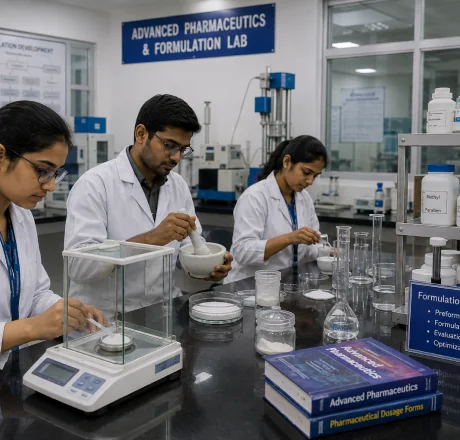
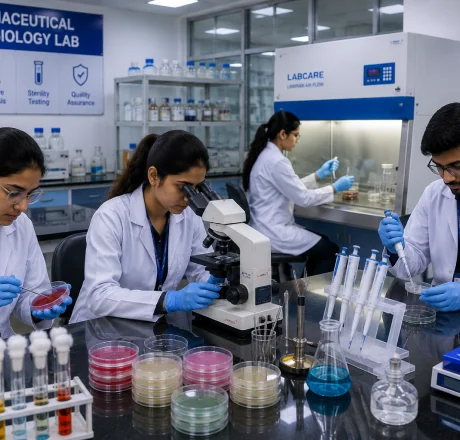
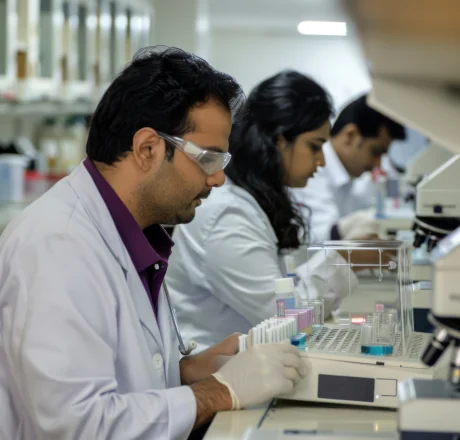
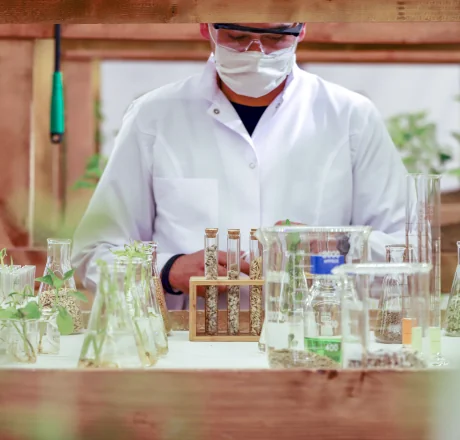
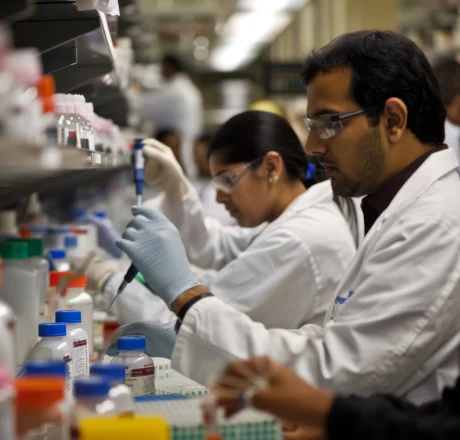
Lateral-entry students at PCU do not start from scratch in the laboratory — they build on it. Entering at Semester III, students engage immediately with advanced pharmaceutical laboratory work that goes well beyond the dispensing and basic formulation training of their D.Pharm years. PCU's School of Pharmacy provides a full suite of modern, well-equipped laboratories and professional practice environments to support this accelerated, advanced learning. Lateral-entry advantage: students bring proven dispensing, drug-handling, and patient-interaction experience from their D.Pharm training — giving them a practical head-start in clinical and hospital-pharmacy lab sessions.
Advanced Laboratory & Training Environments
Advanced Pharmaceutics & Formulation Lab — Controlled-release systems, novel dosage form development, drug-polymer interactions, and advanced formulation evaluation techniques.
Pharmaceutical Chemistry & Drug Analysis Lab — Organic synthesis of drug molecules, advanced qualitative and quantitative drug analysis, and method development.
Pharmaceutical Microbiology Lab — Sterility testing, antimicrobial assays, fermentation technology, and microbial limit tests.
Pharmacology & Experimental Lab — Advanced pharmacology experiments, drug-receptor studies, dose-response analysis, and neuropharmacology practicals.
Herbal Drug Technology Lab — Phytochemical extraction, standardisation of herbal preparations, and herbal drug formulation.
Instrumental Analysis Lab — HPLC, UV-Vis, IR, and other modern analytical instruments used in pharmaceutical QC/QA.
Industrial Pharmacy & QA Lab — GMP-aligned manufacturing simulations, tablet coating, stability studies, and quality assurance testing protocols.
Computer-Aided Drug Design Lab — In-silico drug design, molecular modelling, and bioinformatics tools for pharmaceutical research.
Practice School & Industrial Training — Compulsory real-world placements in pharmaceutical companies, hospital pharmacy departments, and regulatory agencies — building directly on D.Pharm experience.
Final Year Project Work — Independent supervised pharmaceutical research conducted in Semester VIII, presented as a formal research project.

Advanced Pharmaceutical Sciences
Clinical, Regulatory & Practice
Research & Innovation
Professional & Leadership
Advanced Pharmaceutical Sciences
Clinical, Regulatory & Practice
Research & Innovation
Professional & Leadership
From diploma‑level knowledge to advanced pharmacy‑practice skills.
By the end of the programme, students will be able to apply advanced pharmaceutical‑science knowledge in laboratory and professional‑practice settings, with greater confidence in drug formulation, quality‑control, and pharmacy‑service roles.
Key Skills


From internships to advanced pharmacy‑practice and industry‑linked roles.
Lateral-entry students at PCU enter the B.Pharm programme with real pharmacy practice experience from their D.Pharm years — and the programme builds purposefully on that foundation. Through structured industrial training, practice school placements, research projects, and PCET's Industry Institute Interaction Cell (IIIC), students gain the kind of comprehensive, multi-environment industry exposure that prepares them for day-one contributions in pharmaceutical organisations. For lateral-entry students, this industry exposure is additive — it layers onto the community and hospital pharmacy practice experience already developed during D.Pharm, creating a uniquely well-rounded professional profile.

From D.Pharm‑level practice to advanced pharmacy‑roles and study options.
B.Pharm (Lateral Entry) graduates from PCU are eligible for the full range of career opportunities available to any B.Pharm graduate — pharmacy council registration as a registered pharmacist, roles across pharmaceutical manufacturing, hospital and community pharmacy, regulatory affairs, clinical research, sales, marketing, and academia. The degree also qualifies graduates for M.Pharm, Pharm.D, and Ph.D. programmes. And because lateral-entry graduates bring prior D.Pharm experience, many employers regard them as more practice-ready than fresh graduates. Career Edge: lateral-entry graduates often have one to two years of real pharmacy practice experience from D.Pharm by the time they complete their B.Pharm — a significant advantage in roles requiring patient interaction, dispensing, and drug-store management.
Sectors & Opportunities
Community & Retail Pharmacy — Registered Pharmacist, Pharmacy Manager, Community Pharmacy Owner — with practical D.Pharm dispensing experience already in hand
Hospital & Clinical Pharmacy — Hospital Pharmacist, Clinical Pharmacist, Long-term Care Pharmacist, Consultant Pharmacist
Pharmaceutical Manufacturing — Production Pharmacist, Formulation Scientist, QC/QA Analyst, Regulatory Affairs Associate
Drug Regulatory Affairs — Drug Inspector, Regulatory Affairs Manager, Pharmacovigilance Specialist, Drug Licensing Officer
Clinical Research — Clinical Research Associate, Drug Safety Associate, Pharmacovigilance Analyst, Medical Affairs Specialist
Pharmaceutical Sales & Marketing — Medical Representative, Product Manager, Brand Manager, Sales Executive
Research & Development — R&D Pharmacist, Drug Discovery Researcher, Analytical Research Scientist
Government & Public Health — Public Health Pharmacist, Drug Control Officer, Government Hospital Pharmacist, Military Pharmacist
Academia & Education — Lecturer / Assistant Professor, Academic Researcher, Pharmacy Content Writer / Editor
Entrepreneurship — Pharmaceutical Startup Founder, Generic Drug Manufacturer, Health-Tech Entrepreneur
Further Education (Onward) — M.Pharm (any specialisation), Pharm.D, MBA – Pharmaceutical Management, Ph.D in Pharmaceutical Sciences
How to apply for B.Pharm (Lateral Entry)
B.Pharm (Lateral Entry) is open to candidates who have completed a Diploma in Pharmacy (D.Pharm) from an institution recognised by the Pharmacy Council of India. Admission is governed by PCI regulations and PCU's institutional criteria. Lateral-entry students enter at Semester III (Year 2 equivalent) and complete six semesters to earn the full B.Pharm degree — Semesters I & II are credited on the basis of your D.Pharm qualification. Programme Fee: ₹ 1,60,000 per annum; Admission Fee: ₹ 10,000 (one-time). Scholarship and financial assistance options available.
Who Is Eligible?

A pass in Diploma in Pharmacy (D.Pharm) from a PCI-recognised institution — this is the primary and essential qualification for lateral-entry admission.
Minimum aggregate marks in D.Pharm as specified by PCU and the relevant regulatory authority (contact the admissions team for the current year's minimum percentage requirement).
Compliance with any age, registration, or domicile norms as prescribed by PCI or the State Pharmacy Council, where applicable.
Candidates currently registered or eligible for registration with a State Pharmacy Council after D.Pharm are preferred, though registration at the point of application is not always mandatory — confirm current requirements with the admissions office.
Admission
Apply Online — Apply through the official PCU lateral-entry admissions portal: apply.pcu.edu.in
Submit Documents — Submit D.Pharm mark sheets (all semesters/years), D.Pharm diploma certificate, transfer certificate, valid photo ID, and eligibility proof.
Selection Process — Attend the merit-based selection process or entrance counselling session (as applicable in the admission year).
Accept Your Offer — Receive and accept your admission offer letter.
Confirm Your Seat — Complete fee payment — Programme Fee: ₹ 1,60,000 per annum; Admission Fee: ₹ 10,000.
Regular B.Pharm is a four-year programme starting from Semester I, open to 10+2 Science students. B.Pharm (Lateral Entry) is a three-year programme starting from Semester III, exclusively for D.Pharm graduates. Both programmes lead to the same degree — Bachelor of Pharmacy (B.Pharm) — with identical eligibility for M.Pharm, Pharm.D, pharmacy council registration, and all career pathways. The lateral-entry route simply recognises the prior learning and practical experience gained during D.Pharm.
Convert your D.Pharm into a professional B.Pharm degree with advanced practice and industry‑linked training.
Your D.Pharm diploma is a strong foundation. B.Pharm (Lateral Entry) at the School of Pharmacy, Pimpri Chinchwad University, is the bridge that takes you from that foundation to a full bachelor's degree — with advanced pharmaceutical sciences, clinical training, research experience, and the same B.Pharm qualification that unlocks M.Pharm, Pharm.D, and the full spectrum of pharmacy careers. Three years. Six semesters. The same degree. A stronger professional profile — because you bring real pharmacy practice experience that regular graduates simply do not have. Join PCU's B.Pharm (Lateral Entry) programme and take the next step in your pharmacy career.