
Our Vision
To emerge as a Centre of Excellence in Pharmaceutical Education, Research, and Healthcare Services.
A four‑year professional degree in pharmaceutical sciences and practice.
The Bachelor of Pharmacy (B.Pharm) at Pimpri Chinchwad University is a rigorous, four-year undergraduate programme that prepares students to be pharmaceutical scientists, clinical professionals, and healthcare leaders. Regulated by the Pharmacy Council of India under the B.Pharm Course Regulations 2014, the programme covers a wide spectrum of disciplines — from medicinal chemistry and pharmacology to industrial pharmacy, quality assurance, and pharmaceutical regulatory science.
At PCU, academic rigour is matched by real-world readiness. Students benefit from well-equipped pharmacy laboratories, compulsory industrial training and project work, and a curriculum thoughtfully augmented with multidisciplinary minors, audit courses, ability enhancement courses, and foreign language options — ensuring that every B.Pharm graduate from PCU is not just a pharmaceutical expert, but a well-rounded professional.
Rooted in the noble ethos of pharmacy — where the pharmacist is charged with safeguarding public health and placing patient welfare above all else — the B.Pharm programme at PCU produces graduates who are technically sound, ethically grounded, and equipped to lead across retail pharmacy, hospital pharmacy, pharmaceutical manufacturing, drug regulatory affairs, research, and academia.
To emerge as a Centre of Excellence in Pharmaceutical Education, Research, and Healthcare Services.

From basic sciences to clinical pharmacy and professional practice. The B.Pharm programme at PCU is structured around five core objectives: Academic and Professional Excellence; Industry-Relevant Technical Competence; Social Responsibility and Healthcare Bridge; Leadership and Communication; and Lifelong Learning and Innovation.
Human sciences, pharmaceutics basics, and communication skills.
Semester I
Semester II

School of Pharmacy
From drug formulation to quality control and pharmacy practice.
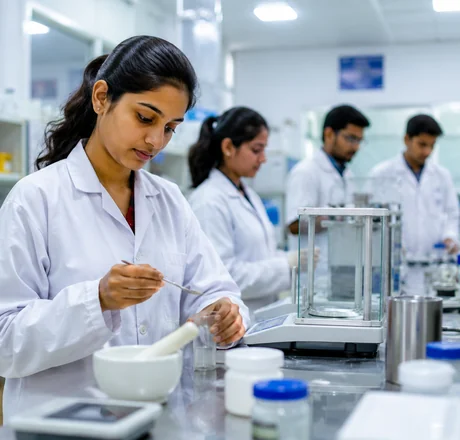
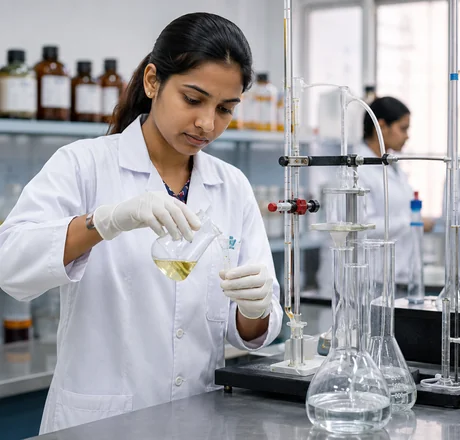
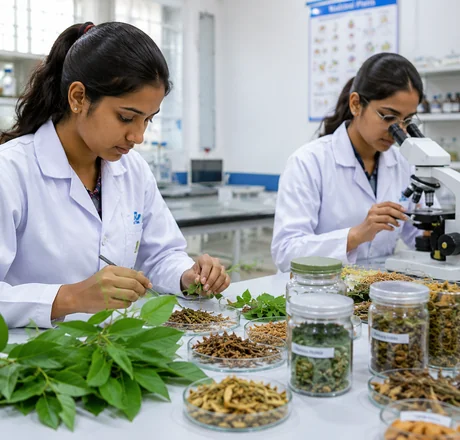
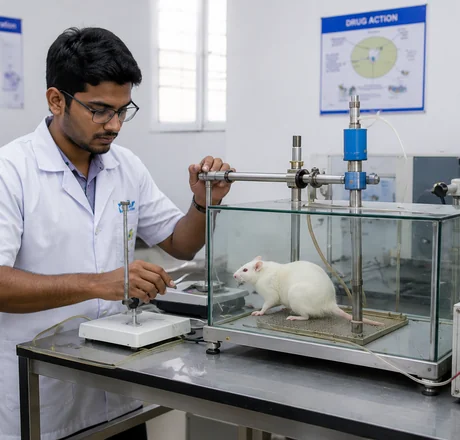
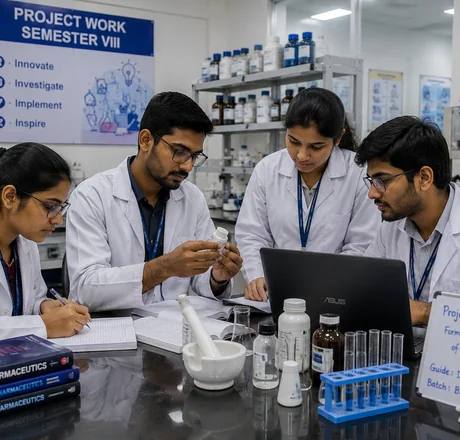
The School of Pharmacy at PCU is equipped with modern, well-maintained laboratories and training facilities that bring every theoretical concept to life. From Year 1 through Year 4, students engage in structured practical sessions that build progressive competence — from basic dosage form preparation and drug analysis to advanced instrumentation, industrial pharmacy, and clinical practice simulations.
Key Laboratory & Training Environments
Pharmaceutics & Dosage Form Lab — Preparation and evaluation of tablets, capsules, ointments, suspensions, emulsions, and controlled-release formulations.
Pharmaceutical Chemistry Lab — Qualitative and quantitative drug analysis, synthesis of organic pharmaceutical compounds, and quality-control exercises.
Pharmacognosy & Phytochemistry Lab — Crude drug identification, extraction and isolation of phytochemicals, herbal standardisation, and natural product analysis.
Pharmacology Lab — Experimental pharmacology, drug screening models, dose-response studies, and neuropharmacology practicals.
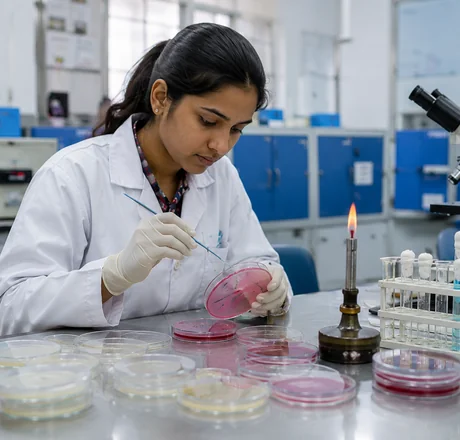
Microbiology Lab — Sterility testing, antimicrobial sensitivity studies, fermentation practicals, and pharmaceutical microbiology techniques.
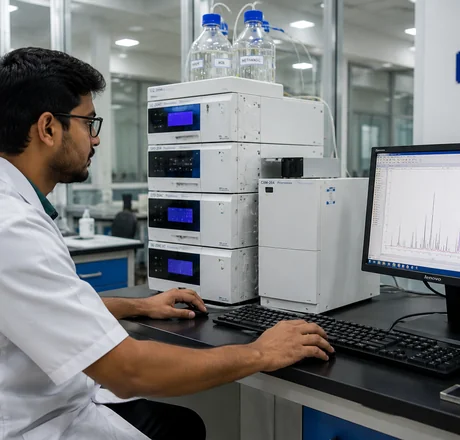
Instrumental Analysis Lab — UV-Visible spectroscopy, HPLC, IR spectroscopy, and other advanced analytical instrument training.
Industrial Pharmacy & Quality Assurance Lab — GMP-oriented manufacturing simulations, tablet coating, quality control testing, and stability studies.
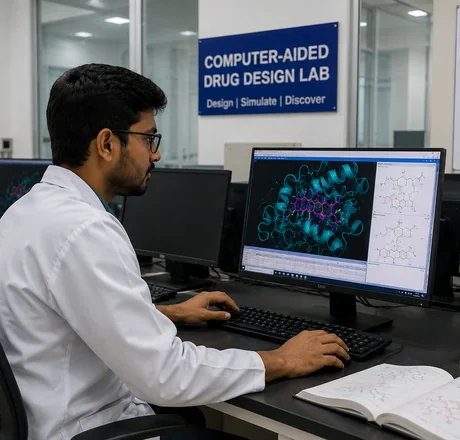
Computer-Aided Drug Design Lab — In-silico drug design tools, molecular modelling software, and pharmaceutical informatics applications.
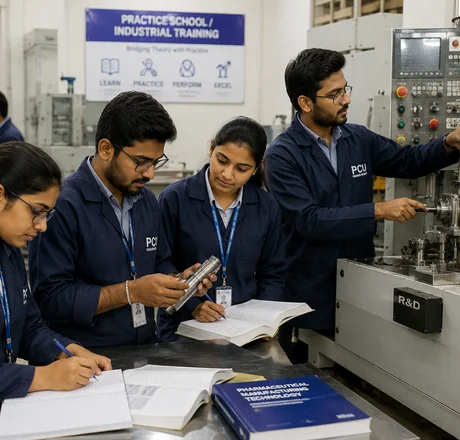
Practice School / Industrial Training — Compulsory placements in pharmaceutical companies, hospital pharmacies, and regulatory bodies.
Project Work (Semester VIII) — Independent research project under faculty mentorship — design, execute, and present original pharmaceutical research.

Pharmaceutical Sciences
Medicinal & Pharmaceutical Chemistry
Pharmacology & Pharmacotherapy
Pharmacognosy & Herbal Technology
Industrial Pharmacy & Quality Assurance
Clinical & Hospital Pharmacy
Pharmaceutical Biotechnology & Drug Delivery
Regulatory Science & Research
Pharmaceutical Sciences
Medicinal & Pharmaceutical Chemistry
Pharmacology & Pharmacotherapy
Pharmacognosy & Herbal Technology
Industrial Pharmacy & Quality Assurance
Clinical & Hospital Pharmacy
Pharmaceutical Biotechnology & Drug Delivery
Regulatory Science & Research
From formulation and analysis to pharmacy practice and patient care.
B.Pharm at PCU is designed to build a comprehensive, employer-valued skill set across technical, analytical, clinical, and professional dimensions. By the time you graduate, you will be equipped to contribute across pharmaceutical research, manufacturing, clinical settings, regulatory affairs, and business.
Key Skills


From internships to pharmacy practice and research.
B.Pharm at PCU goes far beyond classroom and laboratory learning. Through structured industrial training, practice school placements, project work, and PCET's active Industry Institute Interaction Cell (IIIC), students engage directly with the pharmaceutical industry from their very first year — building relationships, professional skills, and career momentum that most graduates only develop after graduation. All industrial training and practice placements are conducted in approved, regulated settings.

Roles in pharmaceuticals, healthcare, research, and regulatory practice.
B.Pharm from PCU opens doors across the full spectrum of pharmaceutical and healthcare careers. Graduates are eligible for pharmacy council registration as registered pharmacists and can work across retail pharmacy, hospital pharmacy, pharmaceutical manufacturing, quality assurance, drug regulatory affairs, research, sales, marketing, and academia. The degree also qualifies graduates for advanced study — M.Pharm, Pharm.D, MBA in Pharmaceutical Management, and Ph.D. programmes.
Sectors & Opportunities
Community & Retail Pharmacy — Registered Pharmacist, Pharmacy Manager, Community Pharmacy Owner, Retail Chain Pharmacist
Hospital & Clinical Pharmacy — Hospital Pharmacist, Clinical Pharmacist, Long-term Care Pharmacist, Consultant Pharmacist
Pharmaceutical Manufacturing — Production Pharmacist, QC/QA Analyst, Regulatory Affairs Associate, Formulation Scientist
Drug Regulatory Affairs — Drug Inspector, Regulatory Affairs Manager, Pharmacovigilance Specialist, Licensing Officer
Pharmaceutical Sales & Marketing — Medical Representative, Product Manager, Brand Manager, Sales Executive, Pharmacy Benefit Manager
Research & Development — Research Pharmacist, R&D Scientist, Clinical Research Associate, Drug Discovery Researcher
Government & Public Health — Public Health Pharmacist, Military Pharmacist, Drug Control Officer, Government Hospital Pharmacist
Academia & Education — Lecturer / Assistant Professor, Academic Researcher, Pharmacy Writer / Editor
Entrepreneurship — Pharmaceutical Startup Founder, Generic Drug Manufacturer, Health-Tech Entrepreneur, Medical Device Distributor
Further Education — M.Pharm, Pharm.D, MBA – Pharmaceutical Management, Ph.D in Pharmaceutical Sciences
How to apply for B.Pharm
Admission to B.Pharm at PCU follows the eligibility requirements prescribed under the B.Pharm Course Regulations 2014 of the Pharmacy Council of India. Programme Fee: ₹ 1,60,000 per annum; Admission Fee: ₹ 10,000 (one-time). Scholarship and financial assistance options available.
Eligibility Criteria

A pass in the 10+2 examination (or equivalent) with English as one of the subjects and Physics, Chemistry, and Mathematics or Biology as optional subjects.
Any other qualification approved by the Pharmacy Council of India as equivalent to the above examination.
The student must have completed the age of 17 years on or before 31st December of the year of admission.
Students from non-formal / open schooling (e.g. NIOS) are not eligible for admission to B.Pharm.
D.Pharm holders may be eligible for B.Pharm Lateral Entry (second year) subject to state and institutional norms.
Admission
Apply Online — Apply through the official PCU admissions portal: apply.pcu.edu.in
Submit Documents — Submit 10+2 mark sheets, transfer certificate, valid photo ID, and eligibility proof.
Selection Process — Attend the merit-based selection process or entrance evaluation (as applicable).
Accept Your Offer — Receive and accept your admission offer letter.
Confirm Your Seat — Complete fee payment — Programme Fee: ₹ 1,60,000 per annum; Admission Fee: ₹ 10,000.
B.Pharm (Bachelor of Pharmacy) is a four-year undergraduate degree that prepares students for professional careers in pharmaceutical sciences, drug development, clinical pharmacy, regulatory affairs, and healthcare. Graduates can work as registered pharmacists in community or hospital pharmacies, join pharmaceutical companies in production, quality control, research, or sales roles, work in government regulatory bodies, pursue academia, or advance into M.Pharm, Pharm.D, or Ph.D. programmes.
Turn your interest in drugs, healthcare, and research into a professional pharmacy practice.
Where Pharmaceutical Science Meets Purpose, Innovation, and Opportunity. B.Pharm at the School of Pharmacy, Pimpri Chinchwad University, gives you more than a degree — it gives you a foundation for a lifelong career at the intersection of science, healthcare, and service. Join a school that combines academic rigour with real-world readiness — laboratory learning, industry placements, multidisciplinary minors, and a dedicated placement cell.